


Page 10 - YunnanTourismCultureTimes (114)
P. 10
09         FOCUS      |   焦点


            Composing a city’s cadence of leisure


            奏响一座城的悠然


        Location: Lijiang
        Narrator: Zhang Jinyuan, manager of Song’s Hualin Xun & Xiao Studio, Shuhe Ancient Town


           In the misty early light of Shuhe Ancient Town, Lijiang, the deep, reso-
        nant sound of the xun, an ancient Chinese ocarina, drifts along the bluestone
        lanes, its earthy tones flowing between traditional Naxi houses. The player,
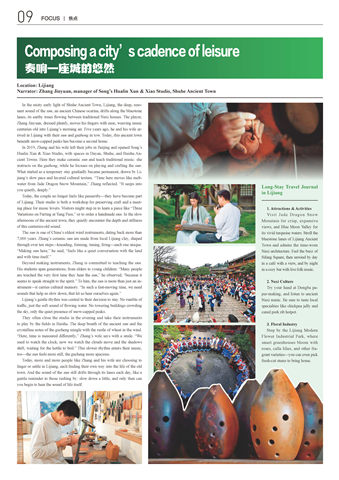
        Zhang Jinyuan, dressed plainly, moves his fingers with ease, weaving music
        centuries old into Lijiang’s morning air. Five years ago, he and his wife ar-
        rived in Lijiang with their xun and guzheng in tow. Today, this ancient town
        beneath snow-capped peaks has become a second home.
           In 2019, Zhang and his wife left their jobs in Beijing and opened Song’s
        Hualin Xun & Xiao Studio, with spaces in Dayan, Shuhe, and Baisha An-
        cient Towns. Here they make ceramic xun and teach traditional music: she
        instructs on the guzheng, while he focuses on playing and crafting the xun.
        What started as a temporary stay gradually became permanent, drawn by Li-
        jiang’s slow pace and layered cultural texture. “Time here moves like melt-
        water from Jade Dragon Snow Mountain,” Zhang reflected. “It seeps into                                       Long-Stay Travel Journal
        you quietly, deeply.”                                                                                        in Lijiang
           Today, the couple no longer feels like passersby—they have become part
        of Lijiang. Their studio is both a workshop for preserving craft and a meet-
        ing place for music lovers. Visitors might step in to learn a piece like “Three                                1. Attractions & Activities
        Variations on Parting at Yang Pass,” or to order a handmade xun. In the slow                                   Visit Jade Dragon Snow
        afternoons of the ancient town, they quietly encounter the depth and stillness                               Mountain for crisp, expansive
        of this centuries-old sound.                                                                                 views, and Blue Moon Valley for
           The xun is one of China’s oldest wind instruments, dating back more than                                  its vivid turquoise waters. Stroll the
        7,000 years. Zhang’s ceramic xun are made from local Lijiang clay, shaped                                    bluestone lanes of Lijiang Ancient
        through over ten steps—kneading, forming, tuning, firing—each one unique.                                    Town and admire the time-worn
        “Making xun here,” he said, “feels like a quiet conversation with the land                                   Naxi architecture. Feel the buzz of
        and with time itself.”                                                                                       Sifang Square, then unwind by day
           Beyond making instruments, Zhang is committed to teaching the xun.                                        in a café with a view, and by night
        His students span generations, from elders to young children. “Many people                                   in a cozy bar with live folk music.
        are touched the very first time they hear the xun,” he observed, “because it
        seems to speak straight to the spirit.” To him, the xun is more than just an in-                               2. Naxi Culture
        strument—it carries cultural memory. “In such a fast-moving time, we need                                      Try your hand at Dongba pa-
        sounds that help us slow down, that let us hear ourselves again.”                                            per-making, and listen to ancient
           Lijiang’s gentle rhythm was central to their decision to stay. No rumble of                               Naxi music. Be sure to taste local
        traffic, just the soft sound of flowing water. No towering buildings crowding                                specialties like chickpea jelly and
        the sky, only the quiet presence of snow-capped peaks.                                                       cured pork rib hotpot.
           They often close the studio in the evening and take their instruments
        to play by the fields in Baisha. The deep breath of the ancient xun and the                                    3. Floral Industry
        crystalline notes of the guzheng mingle with the rustle of wheat in the wind.                                  Stop by the Lijiang Modern
        “Here, time is measured differently,” Zhang’s wife says with a smile. “We                                    Flower Industrial Park, where
        used to watch the clock; now we watch the clouds move and the shadows                                        smart greenhouses bloom with
        shift, waiting for the kettle to boil.” This slower rhythm enters their music,                               roses, calla lilies, and other fra-
        too—the xun feels more still, the guzheng more spacious.                                                     grant varieties—you can even pick
           Today, more and more people like Zhang and his wife are choosing to                                       fresh-cut stems to bring home.
        linger or settle in Lijiang, each finding their own way into the life of the old
        town. And the sound of the xun still drifts through its lanes each day, like a
        gentle reminder to those rushing by: slow down a little, and only then can
        you begin to hear the sound of life itself.

