


Page 15 - YunnanTourismCultureTimes (114)
P. 15
14
                                                                                                                   CITY LIFE     |   城事


        Mai Loan, a student from Hanoi Open University in Viet-  home—these are feelings people everywhere share.” He spoke   fates of peoples across borders, Yunnanese building roads
        nam. Seeing a tube of lipstick that belonged to an American   of the many nations whose people have fought and suffered to   and hauling grain, Southeast Asians risking their lives to aid
        nurse in the airport rescue team brought the past suddenly   defend peace. “That’s why we who live now must cherish it all   the Allies, many joining the fight in Myanmar. “Peace,” he
        near—it was a reminder of the real individuals behind the   the more.” As he finished, applause filled the room—a shared   said, “is built on the courage to stand together.”
        stories. One photo poster drew her attention especially: it   understanding that seemed to hang in the air.  At the camp’s closing ceremony, one participant used AI
        showed a flag with writing not only in English, but also in                                  to bring old photographs of Flying Tigers members to life,
        Myanmar. “Different languages stand for different coun-  Peace is more than the              making them “speak” and “explain” the shark-nose art on
        tries,” she observed. “Peace takes every nation and every                                    their planes. In that moment, technology ceased to be just
        people working together. It isn’t easy to keep, and we young  absence of gunfire             a tool and became a bridge between then and now, quietly
        people need to do our part, too.”                                                            carrying forward a regard for peace.
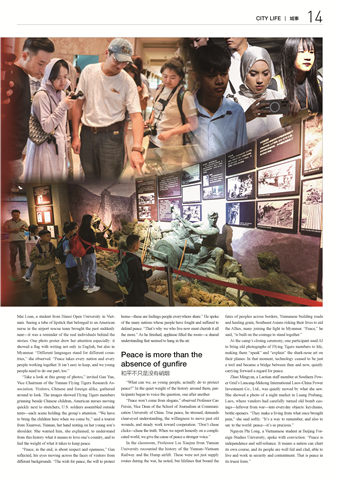
           “Take a look at this group of photos,” invited Gan Yun,   和平不只是没有硝烟                         Zhao Mingyan, a Laotian staff member at Southern Pow-
        Vice Chairman of the Yunnan Flying Tigers Research As-  “What can we, as young people, actually do to protect   er Grid’s Lancang-Mekong International Laos–China Power
        sociation. Visitors, Chinese and foreign alike, gathered   peace?” In the quiet weight of the history around them, par-  Investment Co., Ltd., was quietly moved by what she saw.
        around to look. The images showed Flying Tigers members   ticipants began to voice the question, one after another.  She showed a photo of a night market in Luang Prabang,
        grinning beside Chinese children, American nurses moving   “Peace won’t come from slogans,” observed Professor Cao   Laos, where vendors had carefully turned old bomb cas-
        quickly next to stretchers, U.S. soldiers assembled outside   Peixin, Vice Dean of the School of Journalism at Communi-  ings—leftover from war—into everyday objects: keychains,
        tents—each scene holding the group’s attention. “We have   cation University of China. True peace, he stressed, demands   bottle openers. “They make a living from what once brought
        to bring the children here when we come by,” said a tourist   clear-eyed understanding, the willingness to move past old   pain,” she said softly. “It’s a way to remember, and also to
        from Xuanwei, Yunnan, her hand resting on her young son’s   wounds, and steady work toward cooperation. “Don’t chase   say to the world: peace—it’s so precious.”
        shoulder. She wanted him, she explained, to understand   clicks—chase the truth. When we report honestly on a compli-  Nguyen Phi Long, a Vietnamese student at Beijing For-
        from this history what it means to love one’s country, and to   cated world, we give the cause of peace a stronger voice.”  eign Studies University, spoke with conviction: “Peace is
        feel the weight of what it takes to keep peace.  In the classroom, Professor Liu Xuejun from Yunnan   independence and self-reliance. It means a nation can chart
           “Peace, in the end, is about respect and openness,” Gan   University recounted the history of the Yunnan–Vietnam   its own course, and its people are well fed and clad, able to
        reflected, his eyes moving across the faces of visitors from   Railway and the Hump airlift. These were not just supply   live and work in security and contentment. That is peace in
        different backgrounds. “The wish for peace, the will to protect   routes during the war, he noted, but lifelines that bound the   its truest form.”

