


Page 23 - YunnanTourismCultureTimes (115)
P. 23
SOUTHERN MESSENGERS                 22


        Holding up the sky for “Children of the Stars”

        为“来自星星的孩子”撑起一片天空


           In the sweltering summer of 2009, Sabita Upreti, then   her of “exploiting children for money.” Yet she never gave
        working at the rehabilitation center of the National Disa-  up. Sabita persisted in visiting families door-to-door, pa-
        bility Foundation, entered a slum in Bhaktapur for the first   tiently explaining autism to parents, and gradually winning
        time. Inside a crumbling house, she found an eight-year-old   their trust. “Public awareness has long been lacking,” Sa-
        boy tied to a corner with a rope, his body soiled, his vacant   bita acknowledged. “Children with autism often struggle
        gaze fixed on the flies circling around him. He was autistic,   with basic self-care and communication, and many parents
        and his family had resorted to restraining him with ropes   stop trying to guide them early on. What they really need is
        as a form of "discipline," leaving him to wither like a wild   professional help—and the sooner the better.”
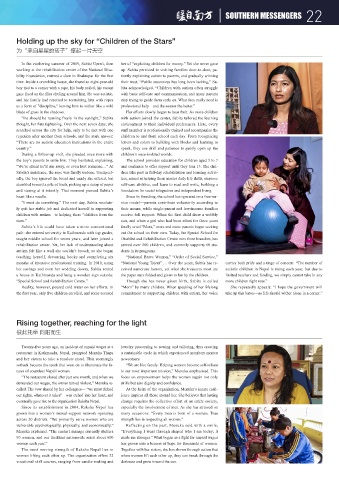
        blade of grass in the shadows.                   Her efforts slowly began to bear fruit. As more children
           “He should be running freely in the sunlight,” Sabita   with autism joined the center, Sabita tailored the learning
        thought, her fists tightening. Over the next seven days, she   environment to their individual preferences. Here, every
        searched across the city for help, only to be met with one   staff member is professionally trained and accompanies the
        rejection after another from schools, and the stark answer:   children to and from school each day. From recognizing
        “There are no autism education institutions in the entire   letters and colors to building with blocks and learning to
        country.”                                      speak, they use skill and patience to gently open up the
           During a follow-up visit, she pleaded once more with   children’s once-isolated worlds.
        the boy’s parents to untie him. They hesitated, explaining,   The school provides education for children aged 3 to 7
        “We’re afraid he’ll run away, or even hurt someone…” At   and continues to offer support until they turn 13. The chil-
        Sabita’s insistence, the rope was finally undone. Unexpect-  dren take part in full-day rehabilitation and learning activi-
        edly, the boy ignored the bread and candy she offered, but   ties, aimed at helping them master daily life skills, improve
        stumbled toward a pile of trash, picking up a scrap of paper   self-care abilities, and learn to read and write, building a
        and staring at it intently. That moment pierced Sabita’s   foundation for social integration and independent living.
        heart like a needle.                             Since its founding, the school has operated on a free-ser-
           “I must do something.” The next day, Sabita resolute-  vice model—parents contribute voluntarily according to
        ly quit her stable job and dedicated herself to supporting   their means, while single-parent and low-income families
        children with autism—to helping these “children from the   receive full support. When the first child drew a wobbly
        stars.”                                        sun, and when a girl who had been silent for three years
           Sabita’s life could have taken a more conventional   finally cried “Mom,” more and more parents began seeking
        path: she entered university in Kathmandu with top grades,   out the school on their own. Today, the Special School for
        taught middle school for seven years, and later joined a   Disabled and Rehabilitation Centre runs three branches, has
        rehabilitation center. Yet, her lack of understanding about   served over 500 children, and currently supports 60 stu-
        autism felt like a wall she couldn’t breach, so she began   dents in its programs.
        teaching herself, devouring books and completing six   “National Brave Woman,” “Order of Social Service,”
        months of intensive professional training. In 2010, using   “National Young Talent” … Over the years, Sabita has re-  carries both pride and a tinge of concern: “The number of
        her savings and even her wedding dowry, Sabita rented   ceived numerous honors, yet what she treasures most are   autistic children in Nepal is rising each year, but due to
        a house in Kathmandu and hung a wooden sign outside:   the paper stars folded and given to her by the children.  limited teachers and funding, we simply cannot take in any
        “Special School and Rehabilitation Centre.”      Though she has never given birth, Sabita is called   more children right now.”
           Reality, however, poured cold water on her efforts. In   “Mom” by many children. When speaking of her lifelong   She repeatedly appeals: “I hope the government will
        the first year, only five children enrolled, and some accused   commitment to supporting children with autism, her voice   take up this baton—no life should wither alone in a corner.”


        Rising together, reaching for the light

        彼此托举 向阳而生


           Twenty‑five years ago, an incident of unpaid wages at a   jewelry processing to sewing and tailoring, thus creating
        restaurant in Kathmandu, Nepal, prompted Menuka Thapa   a sustainable cycle in which experienced members mentor
        and her sisters to take a resolute stand. This seemingly   newcomers.
        setback became the spark that went on to illuminate the fu-  “We are like family. Helping women become self-reliant
        tures of countless Nepali women.               is our most important mission,” Menuka emphasized. This
           “The restaurant closed after just one month, and when we   focus on empowerment helps the women regain not only
        demanded our wages, the owner turned violent,” Menuka re-  skills but also dignity and confidence.
        called. The vow shared by her colleagues— “we must defend   At the helm of the organization, Menuka’s innate resil-
        our rights, whatever it takes”—was etched into her heart, and   ience inspires all those around her. She believes that lasting
        eventually gave rise to the organization Raksha Nepal.  change requires the collective effort of an entire society,
           Since its establishment in 2004, Raksha Nepal has   especially the involvement of men. As she has stressed on
        grown into a women’s mutual-support network operating   many occasions: “Every man is born of a woman. True
        across 20 districts. “We primarily serve women who are   strength lies in respecting all women.”
        vulnerable psychologically, physically, and economically,”   Reflecting on the past, Menuka said with a smile,
        Menuka explained. “The center I manage currently shelters   “Everything I went through shaped who I am today; it
        90 women, and our facilities nationwide assist about 600   made me stronger.” What began as a fight for unpaid wages
        women each year.”                              has grown into a beacon of hope for thousands of women.
           The most moving strength of Raksha Nepal lies in   Together with her sisters, she has shown through action that
        women lifting each other up. The organization offers 32   when women lift each other up, they can break through the
        vocational skill courses, ranging from candle-making and   darkness and grow toward the sun.

