


Page 19 - YunnanTourismCultureTimes (115)
P. 19
18
                                                                                                                  VILLAGES       |   村寨


        在同乐村    触摸            的遗产


                                                  ,


        traditional skills. In recent years, the village has organized   “goat’s song and dance.” As an inheritor of this tradition, Li   Li was preparing to lead the village’s “Achimugua” dance
        over 30 training workshops and held more than 60 perfor-  visits local schools every Wednesday to teach children how   team to perform at the Xianzi (a string instrument) Art Fes-
        mances of “Achimugua” song and dance.          to sing and move with “Achimugua.”            tival in Deqin County. When asked about the importance of
           “The most traditional feature of our village is our   Dressed in the traditional attire “Baji” (meaning “cotton   cultural exchange through dance, he explained, “The Tibet-
        log-cabin houses,” explained Li Biqing, a national-level rep-  clothing” in Lisu), carrying the brightly colored “Hualabiao”   an and Lisu ethnic groups each have their own traditional
        resentative inheritor of the “Achimugua” intangible cultural   (a cross-body bag in Lisu), and wearing a “Kepalahong” (a   dances and attire. While the cultural meanings and spiritual
        heritage. “Livestock are kept on the lower level, and people   felt hat adorned with a pheasant tail feather, symbolizing   messages differ, as an exchange we all want to learn and ap-
        live above. The entire structure is built of wood, assembled   purity and blessings), Li performed a spontaneous “Achimu-  preciate each other’s dance forms.”
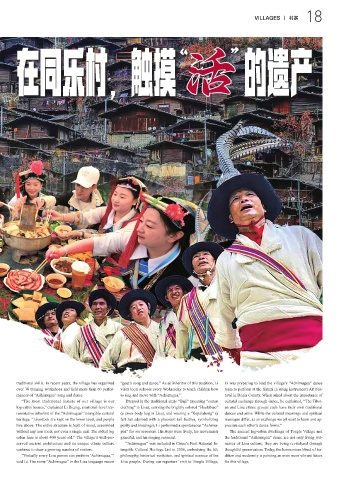
        without any iron tools, not even a single nail. The oldest log   gua” for our reporters. His steps were lively, his movements   The ancient log-cabin dwellings of Tongle Village and
        cabin here is about 400 years old.” The village’s well-pre-  graceful, and his singing resonant.  the traditional “Achimugua” dance are not only living wit-
        served ancient architecture and its unique ethnic culture   “Achimugua” was included in China’s First National In-  nesses of Lisu culture; they are being revitalized through
        continue to draw a growing number of visitors.  tangible Cultural Heritage List in 2006, embodying the life   thoughtful preservation. Today, the harmonious blend of tra-
           “Virtually every Lisu person can perform ‘Achimugua,’”   philosophy, historical evolution, and spiritual essence of the   dition and modernity is painting an even more vibrant future
        said Li. The name “Achimugua” in the Lisu language means   Lisu people. During our reporters’ visit to Tongle Village,   for this village.

