


Page 11 - YunnanTourismCultureTimes (116)
P. 11
10
                                                                                                                     FOCUS       |   焦点


            China-Cambodia Cultural Corridor unveils new arrivals


            中柬文化走廊上新


        By Wang Yunya and Zhang Ruogu                                                                                           □ 王韵雅 张若谷 / 文


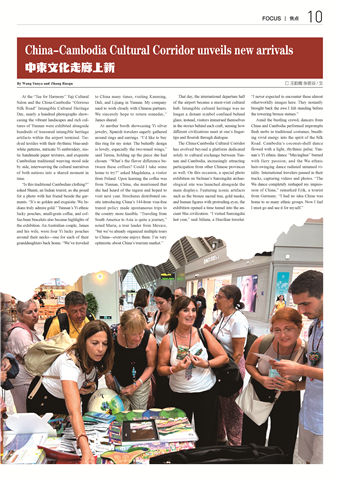
           At the “Tea for Harmony” Yaji Cultural   to China many times, visiting Kunming,   That day, the international departure hall   “I never expected to encounter these almost
        Salon and the China‑Cambodia “Glorious   Dali, and Lijiang in Yunnan. My company   of the airport became a must-visit cultural   otherworldly images here. They instantly
        Silk Road” Intangible Cultural Heritage   used to work closely with Chinese partners.   hub. Intangible cultural heritage was no   brought back the awe I felt standing before
        Day, nearly a hundred photographs show-  We sincerely hope to return someday,”   longer a distant symbol confined behind   the towering bronze statues.”
        casing the vibrant landscapes and rich cul-  James shared.            glass; instead, visitors immersed themselves   Amid the bustling crowd, dancers from
        tures of Yunnan were exhibited alongside   At another booth showcasing Yi silver   in the stories behind each craft, sensing how   China and Cambodia performed impromptu
        hundreds of treasured intangible heritage   jewelry, Spanish travelers eagerly gathered   different civilizations meet at one’s finger-  flash mobs in traditional costumes, breath-
        artifacts within the airport terminal. Tie-  around rings and earrings. “I’d like to buy   tips and flourish through dialogue.  ing vivid energy into the spirit of the Silk
        dyed textiles with their rhythmic blue-and-  this ring for my sister. The butterfly design   The China-Cambodia Cultural Corridor   Road. Cambodia’s coconut-shell dance
        white patterns, intricate Yi embroidery, rus-  is lovely, especially the two-toned wings,”   has evolved beyond a platform dedicated   flowed with a light, rhythmic pulse; Yun-
        tic handmade paper textures, and exquisite   said Teresa, holding up the piece she had   solely to cultural exchange between Yun-  nan’s Yi ethnic dance “Mayinghua” burned
        Cambodian traditional weaving stood side   chosen. “What’s the flavor difference be-  nan and Cambodia, increasingly attracting   with fiery passion; and the Wa ethnic
        by side, interweaving the cultural narratives   tween these coffees? Could I take some   participation from other Chinese provinces   hair-swinging dance radiated untamed vi-
        of both nations into a shared moment in   home to try?” asked Magdalena, a visitor   as well. On this occasion, a special photo   tality. International travelers paused in their
        time.                              from Poland. Upon learning the coffee was   exhibition on Sichuan’s Sanxingdui archae-  tracks, capturing videos and photos. “The
           “Is this traditional Cambodian clothing?”   from Yunnan, China, she mentioned that   ological site was launched alongside the   Wa dance completely reshaped my impres-
        asked Shanti, an Indian tourist, as she posed   she had heard of the region and hoped to   main displays. Featuring iconic artifacts   sion of China,” remarked Erik, a tourist
        for a photo with her friend beside the gar-  visit next year. Brochures distributed on‑  such as the bronze sacred tree, gold masks,   from Germany. “I had no idea China was
        ments. “It’s so golden and exquisite. We In-  site introducing China’s 144‑hour visa‑free   and human figures with protruding eyes, the   home to so many ethnic groups. Now I feel
        dians truly admire gold.” Yunnan’s Yi ethnic   transit policy made spontaneous trips to   exhibition opened a time tunnel into the an-  I must go and see it for myself.”
        lucky pouches, small‑grain coffee, and cof-  the country more feasible. “Traveling from   cient Shu civilization. “I visited Sanxingdui
        fee-bean bracelets also became highlights of   South America to Asia is quite a journey,”   last year,” said Juliana, a Brazilian traveler.
        the exhibition. An Australian couple, James   noted Maria, a tour leader from Mexico,
        and his wife, wore four Yi lucky pouches   “but we’ve already organized multiple tours
        around their necks—one for each of their   to China—everyone enjoys them. I’m very
        granddaughters back home. “We’ve traveled   optimistic about China’s tourism market.”

