


Page 19 - YunnanTourismCultureTimes (114)
P. 19
18
                                                                                                                  VILLAGES       |   村寨


        From bare hills to a home of promise                                 The renewed Simola quickly became a favorite backdrop for social-media influenc-
                                                                           ers. With official encouragement, Zhao opened one of the village’s first homestays. In
        “穷窝窝”变“金窝窝”                                                        spring 2016, Simola hosted its first large-scale performance and Long Street Banquet,
                                                                           drawing more than 3,000 visitors and filling over a hundred tables. Cars lined the road
           In earlier years, Simola’s reality didn’t live up to its hopeful name. Perched on a   for miles—and everyone suddenly saw the possibility.
        mountainside, the village faced slopes so steep that its paddy fields, barely more than one
        mu per person, couldn’t hold water in the rains or be irrigated in dry spells. Simply having   Dreams blooming in Wa homeland
        enough to eat was a constant struggle. The single narrow path to town meant every trip re-
        quired hauling goods by back or by horse, turning a visit into a dawn-to-dusk journey. With   梦想在佤乡开花
        few options, more than 80 percent of the village’s able-bodied adults left to find work else-
        where, turning Simola into what locals called an “empty-shell” village.  Word of Simola’s renewal began to travel, and before long, young people started re-
           Today, Simola Village has long since transformed.               turning home.
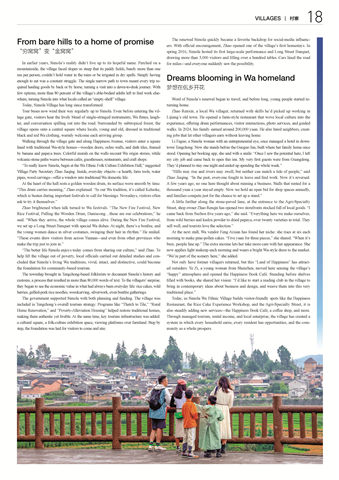
           Tour buses now wind their way regularly up to Simola. Even before entering the vil-  Zhao Renxin, a local Wa villager, returned with skills he’d picked up working in
        lage gate, visitors hear the lively blend of single-stringed instruments, Wa flutes, laugh-  Lijiang’s old town. He opened a farm-style restaurant that wove local culture into the
        ter, and conversation spilling out into the road. Surrounded by subtropical forest, the   experience, offering drum performances, visitor interactions, photo services, and guided
        village opens onto a central square where locals, young and old, dressed in traditional   walks. In 2024, his family earned around 200,000 yuan. He also hired neighbors, creat-
        black and red Wa clothing, warmly welcome each arriving group.     ing jobs that let other villagers earn without leaving home.
           Walking through the village gate and along Happiness Avenue, visitors enter a square   Li Faguo, a Simola woman with an entrepreneurial eye, once managed a hotel in down-
        lined with traditional Wa-style homes—wooden doors, ochre walls, and dark tiles, framed   town Tengchong. Now she stands before the Guoguo Inn, built where her family home once
        by banana and papaya trees. Colorful murals on the walls recount Wa origin stories, while   stood. Opening her booking app, she said with a smile: “Once I saw the potential here, I left
        volcanic-stone paths weave between cafés, guesthouses, restaurants, and craft shops.  my city job and came back to open this inn. My very first guests were from Guangdong.
           “To really know Simola, begin at the Wa Ethnic Folk Culture Exhibition Hall,” suggested   They’d planned to stay one night and ended up spending the whole week.”
        Village Party Secretary Zhao Jiaqing. Inside, everyday objects—a hearth, farm tools, water   “Hills may rise and rivers may swell, but neither can match a tide of people,” said
        pipes, wood carvings—offer a window into traditional Wa domestic life.  Zhao Jiaqing. “In the past, everyone fought to leave and find work. Now it’s reversed.
           At the heart of the hall rests a golden wooden drum, its surface worn smooth by time.   A few years ago, no one here thought about running a business. Stalls that rented for a
        “This drum carries meaning,” Zhao explained. “In our Wa tradition, it’s called Keluoke,   thousand yuan a year stayed empty. Now we hold an open bid for shop spaces annually,
        which is beaten during important festivals to call for blessings. Nowadays, visitors often   and families compete just for the chance to set up a stand.”
        ask to try it themselves.”                                           A little farther along the stone-paved lane, at the entrance to the Agri-Specialty
           Zhao brightened when talk turned to Wa festivals. “The New Fire Festival, New   Street, shop owner Zhao Renqin has opened two storefronts stocked full of local goods. “I
        Rice Festival, Pulling the Wooden Drum, Daniucong…these are our celebrations,” he   came back from Suzhou five years ago,” she said. “Everything here we make ourselves,
        said. “When they arrive, the whole village comes alive. During the New Fire Festival,   from wild berries and kudzu powder to dried papaya, over twenty varieties in total. They
        we set up a Long Street Banquet with special Wa dishes. At night, there’s a bonfire, and   sell well, and tourists love the selection.”
        the young women dance in silver costumes, swinging their hair in rhythm.” He smiled.   At the next stall, Wa vendor Feng Aixian has found her niche: she rises at six each
        “These events draw visitors from across Yunnan—and even from other provinces who   morning to make pine-pollen cakes. “Five yuan for three pieces,” she shared. “When it’s
        make the trip just to join in.”                                    busy, people line up.” The extra income lets her take more care with her appearance. She
           “The better life Simola enjoys today comes from sharing our culture,” said Zhao. To   now applies light makeup each morning and wears a bright Wa-style dress to the market.
        help lift the village out of poverty, local officials carried out detailed studies and con-  “We’re part of the scenery here,” she added.
        cluded that Simola’s living Wa traditions, vivid, intact, and distinctive, could become   Not only have former villagers returned, but this “Land of Happiness” has attract-
        the foundation for community-based tourism.                        ed outsiders. Ye Zi, a young woman from Shenzhen, moved here sensing the village’s
           The township brought in Tengchong-based folklorists to document Simola’s history and   “happy” atmosphere and opened the Happiness Book Café. Standing before shelves
        customs, a process that resulted in more than 80,000 words of text. To the villagers’ surprise,   filled with books, she shared her vision: “I’d like to start a reading club in the village to
        they began to see the economic value in what had always been everyday life: rice cakes, wild   bring in contemporary ideas about business and design, and weave them into this very
        berries, grilled-pork rice noodles, woodcarving, silverwork, even bonfire gatherings.  traditional place.”
           The government supported Simola with both planning and funding. The village was   Today, as Simola Wa Ethnic Village builds visitor-friendly spots like the Happiness
        included in Tengchong’s overall tourism strategy. Programs like “Thatch to Tile,” “Rural   Restaurant, the Rice Cake Experience Workshop, and the Agri-Specialty Street, it is
        Home Renovation,” and “Poverty-Alleviation Housing” helped restore traditional homes,   also steadily adding new services—the Happiness Book Café, a coffee shop, and more.
        making them authentic yet livable. At the same time, key tourism infrastructure was added:   Through managed tourism, rental income, and local enterprise, the village has created a
        a cultural square, a folk-culture exhibition space, viewing platforms over farmland. Step by   system in which every household earns, every resident has opportunities, and the com-
        step, the foundation was laid for visitors to come and stay.       munity as a whole prospers.

