


Page 20 - YunnanTourismCultureTimes (117)
P. 20
19         FOOD      |   好吃


          A sip of sour tea, a taste of millennial wisdom


          一口酸茶,吃出千年智慧


          By our staff correspondents                                                       □ 本刊综合
             A treasure of the East and a bridge between friends, tea carries within it the phi-
          losophy of “harmony in diversity,” linking hearts across the globe. Yunnan, the an-
          cestral home of the world’s tea trees and a primordial cradle of tea culture, has
          been shaped and sustained by these leaves for millennia. From this ancient
          bond have sprung vibrant tea tree ecosystems, a rich tapestry of tea tradi-
          tions, and the thriving modern tea industry of Yunnan.
             In Yunnan, tea serves purposes beyond brewing. The Bulang peo-
          ple’s sour tea, for instance, is preserved and fermented like pickled
          vegetables. It can be chewed directly, mixed into dishes, or
          even presented as a betrothal gift.


                                                    它承载
                 是东方文明的瑰宝,
                                  也是连接友谊的桥梁,
              茶,
              茶,是东方文明的瑰宝,也是连接友谊的桥梁,它承载
          着“和而不同”的哲学思想,连接起世界各国人民的情感
          着 “和而不同     ”的哲学思想     ,连接起世界各国人民的情感
                                      ,是最早的茶文化发祥
                    ,是世界茶树的起源地
          纽带
          纽带。云南,是世界茶树的起源地,是最早的茶文化发祥
              。云南
          地之一   。千年的东方树叶哺育和滋养了云南人民               ,成就了
          地之一。千年的东方树叶哺育和滋养了云南人民,成就了
          丰富多元的古茶树群落,衍生出了多姿多彩的茶文化,造
          丰富多元的古茶树群落         ,衍生出了多姿多彩的茶文化           ,造
          就了欣欣向荣的云茶产业。
          就了欣欣向荣的云茶产业。
                                     还可以像腌菜一样封存发
                     茶不仅可以用来泡,
              在云南,
              在云南,茶不仅可以用来泡,还可以像腌菜一样封存发
              嚼着吃、
                    拌着吃、
          酵,嚼着吃、拌着吃、甚至当聘礼——这就是布朗族的酸茶。
          酵,
                           甚至当聘礼——这就是布朗族的酸茶。
          Fermented tea, edible brew
          是茶叶,也是腌菜
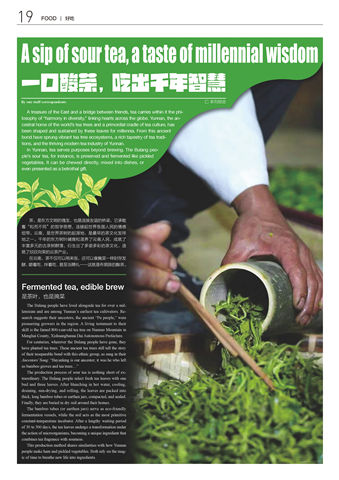
             The Bulang people have lived alongside tea for over a mil-
          lennium and are among Yunnan’s earliest tea cultivators. Re-
          search suggests their ancestors, the ancient “Pu people,” were
          pioneering growers in the region. A living testament to their
          skill is the famed 800-year-old tea tree on Nannuo Mountain in
          Menghai County, Xishuangbanna Dai Autonomous Prefecture.
             For centuries, wherever the Bulang people have gone, they
          have planted tea trees. These ancient tea trees still tell the story
          of their inseparable bond with this ethnic group, as sung in their
          Ancestors’ Song: “Bayanleng is our ancestor; it was he who left
          us bamboo groves and tea trees…”
             The production process of sour tea is nothing short of ex-
          traordinary. The Bulang people select fresh tea leaves with one
          bud and three leaves. After blanching in hot water, cooling,
          draining, sun-drying, and rolling, the leaves are packed into
          thick, long bamboo tubes or earthen jars, compacted, and sealed.
          Finally, they are buried in dry soil around their homes.
             The bamboo tubes (or earthen jars) serve as eco-friendly
          fermentation vessels, while the soil acts as the most primitive
          constant-temperature incubator. After a lengthy waiting period
          of 30 to 300 days, the tea leaves undergo a transformation under
          the action of microorganisms, becoming a unique ingredient that
          combines tea fragrance with sourness.
             This production method shares similarities with how Yunnan
          people make ham and pickled vegetables. Both rely on the mag-
          ic of time to breathe new life into ingredients.

