


Page 21 - YunnanTourismCultureTimes (117)
P. 21
20
                                                                                                                       FOOD      |   好吃


        A versatile tea dish, for chewing and brewing

        能嚼能泡的“万能茶菜”

           In Shuangjiang Lahu, Wa, Bulang, and Dai Autono-  ly. Initially, the taste is sour and astringent, with a hint
        mous County, the unveiling of Bulang sour tea is a cere-  of bitterness. But as you continue to chew, a refreshing
        monial act. Respected elders hold an offering of freshly   sweetness gradually fills the mouth, leaving a long-lasting
        steeped tea, recite blessings in the Bulang language over   aftertaste.
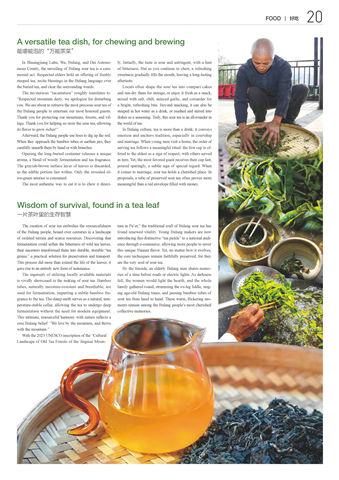
        the buried tea, and clear the surrounding weeds.  Locals often shape the sour tea into compact cakes
           The mysterious “incantation” roughly translates to:   and sun-dry them for storage, or enjoy it fresh as a snack,
        “Respected mountain deity, we apologize for disturbing   mixed with salt, chili, minced garlic, and coriander for
        you. We are about to retrieve the most precious sour tea of   a bright, refreshing bite. Beyond snacking, it can also be
        the Bulang people to entertain our most honored guests.   steeped in hot water as a drink, or mashed and stirred into
        Thank you for protecting our mountains, forests, and vil-  dishes as a seasoning. Truly, this sour tea is an all-rounder in
        lage. Thank you for helping us store the sour tea, allowing   the world of tea.
        its flavor to grow richer!”                    In Bulang culture, tea is more than a drink; it conveys
           Afterward, the Bulang people use hoes to dig up the soil.   emotion and anchors tradition, especially in courtship
        When they approach the bamboo tubes or earthen jars, they   and marriage. When young men visit a home, the order of
        carefully unearth them by hand or with branches.  serving tea follows a meaningful ritual: the first cup is of-
           Opening the long-buried container releases a unique   fered to the eldest as a sign of respect, with others served
        aroma, a blend of woody fermentation and tea fragrance.   in turn. Yet, the most favored guest receives their cup last,
        The grayish-brown surface layer of leaves is discarded,   poured sparingly, a subtle sign of special regard. When
        as the edible portion lies within. Only the revealed ol-  it comes to marriage, sour tea holds a cherished place. In
        ive-green interior is consumed.              proposals, a tube of preserved sour tea often proves more
           The most authentic way to eat it is to chew it direct-  meaningful than a red envelope filled with money.


        Wisdom of survival, found in a tea leaf


        一片茶叶里的生存智慧

           The creation of sour tea embodies the resourcefulness   tain in Pu’er,” the traditional craft of Bulang sour tea has
        of the Bulang people, honed over centuries in a landscape   found renewed vitality. Young Bulang makers are now
        of isolated terrain and scarce resources. Discovering that   introducing this distinctive “tea pickle” to a national audi-
        fermentation could soften the bitterness of wild tea leaves,   ence through e-commerce, allowing more people to savor
        their ancestors transformed them into durable, storable “tea   this unique Yunnan flavor. Yet, no matter how it evolves,
        grains,” a practical solution for preservation and transport.   the core techniques remain faithfully preserved, for they
        This process did more than extend the life of the leaves; it   are the very soul of sour tea.
        gave rise to an entirely new form of sustenance.  By the fireside, an elderly Bulang man shares memo-
           The ingenuity of utilizing locally available materials   ries of a time before roads or electric lights. As darkness
        is vividly showcased in the making of sour tea. Bamboo   fell, the women would light the hearth, and the whole
        tubes, naturally moisture-resistant and breathable, are   family gathered round, strumming the ox-leg fiddle, sing-
        used for fermentation, imparting a subtle bamboo fra-  ing age-old Bulang tunes, and passing bamboo tubes of
        grance to the tea. The damp earth serves as a natural, tem-  sour tea from hand to hand. These warm, flickering mo-
        perature-stable cellar, allowing the tea to undergo deep   ments remain among the Bulang people’s most cherished
        fermentation without the need for modern equipment.   collective memories.
        This intimate, resourceful harmony with nature reflects a
        core Bulang belief: “We live by the mountain, and thrive
        with the mountain.”
           With the 2023 UNESCO inscription of the “Cultural
        Landscape of Old Tea Forests of the Jingmai Moun-

