


Page 17 - YunnanTourismCultureTimes (117)
P. 17
16
                                                                                                                   CITY LIFE     |   城事


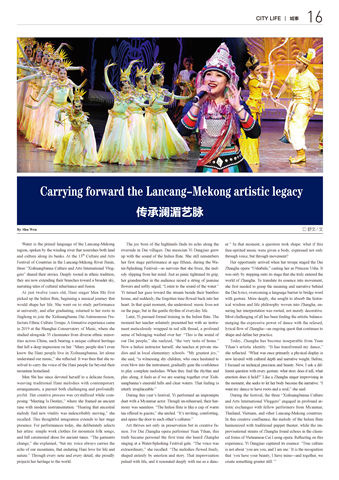
                  Carrying forward the Lancang‑Mekong artistic legacy


                                                             传承澜湄艺脉


        By Shu Wen                                                                                                                     □ 舒文 / 文


           Water is the primal language of the Lancang-Mekong   The joy born of the highlands finds its echo along the   er.” In that moment, a question took shape: what if this
        region, spoken by the winding river that nourishes both land   riverside in Dai villages. Dai musician Yi Dangjiao grew   free-spirited music were given a body, expressed not only
                                      th
        and culture along its banks. At the 13  Culture and Arts   up with the sound of the hulusi flute. She still remembers   through voice, but through movement?
        Festival of Countries in the Lancang-Mekong River Basin,   her first stage performance at age fifteen, during the Wa-  Her opportunity arrived when her troupe staged the Dai
        three “Xishuangbanna Culture and Arts International Vlog-  ter-Splashing Festival—so nervous that she froze, the mel-  Zhangha opera “Ushabala,” casting her as Princess Usha. It
        gers” shared their stories. Deeply rooted in ethnic tradition,   ody slipping from her mind. Just as panic tightened its grip,   was only by stepping onto its stage that she truly entered the
        they are now extending their branches toward a broader sky,   her grandmother in the audience raised a string of jasmine   world of Zhangha. To translate its essence into movement,
        narrating tales of cultural inheritance and fusion.  flowers and softly urged, “Listen to the sound of the water.”   she first needed to grasp the meaning and narrative behind
           At just twelve years old, Hani singer Men Shi first   Yi turned her gaze toward the stream beside their bamboo   the Dai lyrics, overcoming a language barrier to bridge word
        picked up the hulusi flute, beginning a musical journey that   house, and suddenly, the forgotten tune flowed back into her   with gesture. More deeply, she sought to absorb the histor-
        would shape her life. She went on to study performance   heart. In that quiet moment, she understood: music lives not   ical wisdom and life philosophy woven into Zhangha, en-
        at university, and after graduating, returned to her roots in   on the page, but in the gentle rhythm of everyday life.  suring her interpretation was rooted, not merely decorative.
        Jinghong to join the Xishuangbanna Dai Autonomous Pre-  Later, Yi pursued formal training in the hulusi flute. The   Most challenging of all has been finding the artistic balance:
        fecture Ethnic Culture Troupe. A formative experience came   moment her teacher solemnly presented her with an instru-  merging the expressive power of dance with the relaxed,
        in 2019 at the Shanghai Conservatory of Music, where she   ment meticulously wrapped in red silk thread, a profound   lyrical flow of Zhangha—an ongoing quest that continues to
        studied alongside 35 classmates from diverse ethnic minor-  sense of belonging washed over her: “This is the sound of   shape and define her practice.
        ities across China, each bearing a unique cultural heritage   our Dai people,” she realized, “the very taste of home.”   Today, Zhangha has become inseparable from Yuan
        that left a deep impression on her. “Many people don’t even   Now a hulusi instructor herself, she teaches at private stu-  Yihan’s artistic identity. “It has transformed my dance,”
        know the Hani people live in Xishuangbanna, let alone   dios and in local elementary schools. “My greatest joy,”   she reflected. “What was once primarily a physical display is
        understand our music,” she reflected. It was then that she re-  she said, “is witnessing shy children, who once hesitated to   now layered with cultural depth and narrative weight. Before,
        solved to carry the voice of the Hani people far beyond their   even blow into the instrument, gradually gain the confidence   I focused on technical precision and beauty. Now, I ask a dif-
        mountain homeland.                             to play complete melodies. When they find the rhythm and   ferent question with every gesture: what story does it tell, what
           Men Shi has since devoted herself to a delicate fusion,   play along, it feels as if we are soaring together over Xish-  emotion does it hold?” Like a Zhangha singer improvising in
        weaving traditional Hani melodies with contemporary   uangbanna’s emerald hills and clear waters. That feeling is   the moment, she seeks to let her body become the narrative. “I
        arrangements, a pursuit both challenging and profoundly   utterly irreplaceable.”            want my dance to have roots and a soul,” she said.
        joyful. Her creative process was crystallized while com-  During this year’s festival, Yi performed an impromptu   During the festival, the three “Xishuangbanna Culture
        posing “Meeting Is Destiny,” where she framed an ancient   duet with a Myanmar actor. Though un-rehearsed, their har-  and Arts International Vloggers” engaged in profound ar-
        tune with modern instrumentation. “Hearing that ancestral   mony was seamless. “The hulusi flute is like a cup of warm   tistic exchanges with fellow performers from Myanmar,
        melody find new vitality was indescribably moving,” she   tea offered to guests,” she smiled. “It’s inviting, comforting,   Thailand, Vietnam, and other Lancang-Mekong countries.
        recalled. This thoughtful integration extends to her stage   and opens the door to each other’s cultures.”  In this creative confluence, the melody of the hulusi flute
        presence. For performances today, she deliberately selects   Art thrives not only in preservation but in creative fu-  harmonized with traditional puppet theater, while the im-
        her attire: simple work clothes for mountain folk songs,   sion. For Dai Zhangha opera performer Yuan Yihan, this   provisational strains of Zhangha found echoes in the classi-
        and full ceremonial dress for ancient tunes. “The garments   truth became personal the first time she heard Zhangha   cal forms of Vietnamese Cai Luong opera. Reflecting on this
        change,” she explained, “but my voice always carries the   singing at a Water-Splashing Festival gala. “The voice was   experience, Yi Dangjiao captured its essence: “True culture
        echo of our mountains, that enduring Hani love for life and   extraordinary,” she recalled. “The melodies flowed freely,   is not about ‘you are you, and I am me.’ It is the recognition
        nature.” Through every note and every detail, she proudly   shaped entirely by emotion and story. That improvisation   that ‘you have your beauty, I have mine—and together, we
        projects her heritage to the world.            pulsed with life, and it resonated deeply with me as a danc-  create something greater still.’”

