


Page 7 - YunnanTourismCultureTimes (112)
P. 7
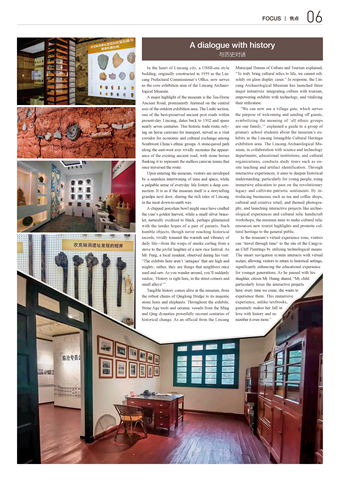
06
                                                                                                                     FOCUS       |   焦点


                                                                                     A dialogue with history

                                                                                                  与历史对话


                                                                  In the heart of Lincang city, a USSR-era style   Municipal Bureau of Culture and Tourism explained,
                                                                building, originally constructed in 1959 as the Lin-  “To truly bring cultural relics to life, we cannot rely
                                                                cang Prefectural Commissioner’s Office, now serves   solely on glass display cases.” In response, the Lin-
                                                                as the core exhibition area of the Lincang Archaeo-  cang Archaeological Museum has launched three
                                                                logical Museum.                           major initiatives: integrating culture with tourism,
                                                                  A major highlight of the museum is the Tea-Horse   empowering exhibits with technology, and vitalizing
                                                                Ancient Road, prominently featured on the central   their utilization.
                                                                axis of the outdoor exhibition area. The Lushi section,   “We can now see a village gate, which serves
                                                                one of the best-preserved ancient post roads within   the purpose of welcoming and sending off guests,
                                                                present-day Lincang, dates back to 1302 and spans   symbolizing the meaning of ‘all ethnic groups
                                                                nearly seven centuries. This historic trade route, rely-  are one family,’” explained a guide to a group of
                                                                ing on horse caravans for transport, served as a vital   primary school students about the museum’s ex-
                                                                corridor for economic and cultural exchange among   hibits in the Lincang Intangible Cultural Heritage
                                                                Southwest China’s ethnic groups. A stone-paved path   exhibition area. The Lincang Archaeological Mu-
                                                                along the east-west axis vividly recreates the appear-  seum, in collaboration with science and technology
                                                                ance of the existing ancient road, with stone horses   departments, educational institutions, and cultural
                                                                flanking it to represent the endless caravan teams that   organizations, conducts study tours such as on-
                                                                once traversed the route.                 site teaching and artifact identification. Through
                                                                  Upon entering the museum, visitors are enveloped   interactive experiences, it aims to deepen historical
                                                                by a seamless intertwining of time and space, while   understanding, particularly for young people, using
                                                                a palpable sense of everyday life fosters a deep con-  immersive education to pass on the revolutionary
                                                                nection. It is as if the museum itself is a storytelling   legacy and cultivate patriotic sentiments. By in-
                                                                grandpa next door, sharing the rich tales of Lincang   troducing businesses such as tea and coffee shops,
                                                                in the most down-to-earth way.            cultural and creative retail, and themed photogra-
                                                                  A chipped porcelain bowl might once have cradled   phy, and launching interactive projects like archae-
                                                                the year’s golden harvest, while a small silver brace-  ological experiences and cultural relic handicraft
                                                                let, naturally oxidized to black, perhaps glimmered   workshops, the museum aims to make cultural relic
                                                                with the tender hopes of a pair of parents. Such   resources new tourist highlights and promote cul-
                                                                humble objects, though never reaching historical   tural heritage to the general public.
                                                                records, vividly transmit the warmth and vibrancy of   In the museum’s virtual experience zone, visitors
                                                                daily life—from the wisps of smoke curling from a   can “travel through time” to the site of the Cangyu-
                                                                stove to the joyful laughter of a new rice festival. As   an Cliff Paintings by utilizing technological means.
                                                                Mr. Peng, a local resident, observed during his visit:   The smart navigation system interacts with virtual
                                                                “The exhibits here aren’t ‘antiques’ that are high and   scenes, allowing visitors to return to historical settings,
                                                                mighty; rather, they are things that neighbors once   significantly enhancing the educational experience
                                                                used and saw. As you wander around, you’ll suddenly   for younger generations. As he paused with his
                                                                realize, ‘History is right here, in the street corners and   daughter, citizen Mr. Huang shared, “My child
                                                                small alleys!’”                           particularly loves the interactive projects
                                                                  Tangible history comes alive at the museum, from   here; every time we come, she wants to
                                                                the robust chains of Qinglong Bridge to its majestic   experience them. This immersive
                                                                stone lions and elephants. Throughout the exhibits,   experience, unlike textbooks,
                                                                Stone Age tools and ceramic vessels from the Ming   genuinely makes her fall in
                                                                and Qing dynasties powerfully recount centuries of   love with history and re-
                                                                historical change. As an official from the Lincang   member it even more.”

