


Page 8 - YunnanTourismCultureTimes (112)
P. 8
07         FOCUS      |   焦点


                                                      Discovering the “Animal Kingdom”

                                                                         探秘“动物王国”


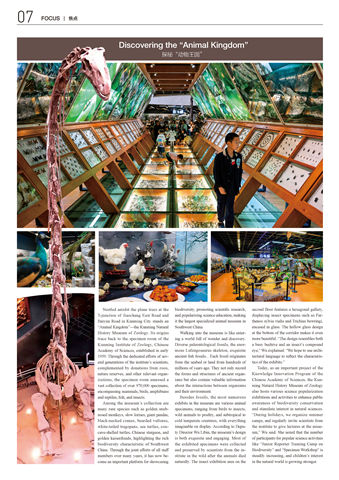
                                               Nestled amidst the plane trees at the   biodiversity, promoting scientific research,   second floor features a hexagonal gallery,
                                            T-junction of Jiaochang East Road and   and popularizing science education, making   displaying insect specimens such as Par-
                                            Baiyun Road in Kunming City stands an   it the largest specialized animal museum in   thenos sylvia vialis and Trichius bowringi,
                                            “Animal Kingdom”—the Kunming Natural   Southwest China.              encased in glass. The hollow glass design
                                            History Museum of Zoology. Its origins   Walking into the museum is like enter-  at the bottom of the corridor makes it even
                                            trace back to the specimen room of the   ing a world full of wonder and discovery.   more beautiful. “The design resembles both
                                            Kunming Institute of Zoology, Chinese   Diverse paleontological fossils, the enor-  a busy beehive and an insect’s compound
                                            Academy of Sciences, established in early   mous Lufengosaurus skeleton, exquisite   eye,” Wu explained. “We hope to use archi-
                                            1959. Through the dedicated efforts of sev-  ancient fish fossils... Each fossil originates   tectural language to reflect the characteris-
                                            eral generations of the institute’s scientists,   from the seabed or land from hundreds of   tics of the exhibits.”
                                            complemented by donations from zoos,   millions of years ago. They not only record   Today, as an important project of the
                                            nature reserves, and other relevant organ-  the forms and structures of ancient organ-  Knowledge Innovation Program of the
                                            izations, the specimen room amassed a   isms but also contain valuable information   Chinese Academy of Sciences, the Kun-
                                            vast collection of over 970,000 specimens,   about the interactions between organisms   ming Natural History Museum of Zoology
                                            encompassing mammals, birds, amphibians   and their environment.     also hosts various science popularization
                                            and reptiles, fish, and insects.     Besides fossils, the most numerous   exhibitions and activities to enhance public
                                               Among the museum’s collection are   exhibits in the museum are various animal   awareness of biodiversity conservation
                                            many rare species such as golden snub-  specimens, ranging from birds to insects,   and stimulate interest in natural sciences.
                                            nosed monkeys, slow lorises, giant pandas,   wild animals to poultry, and subtropical to   “During holidays, we organize summer
                                            black-necked cranes, bearded vultures,   cold temperate creatures, with everything   camps, and regularly invite scientists from
                                            white-tailed tragopans, sea turtles, con-  imaginable on display. According to Depu-  the institute to give lectures at the muse-
                                            cave-shelled turtles, Chinese sturgeon, and   ty Director Wu Libin, the museum’s design   um,” Wu said. She noted that the number
                                            golden kaiserihinds, highlighting the rich   is both exquisite and engaging. Most of   of participants for popular science activities
                                            biodiversity characteristic of Southwest   the exhibited specimens were collected   like “Junior Reporter Training Camp on
                                            China. Through the joint efforts of all staff   and preserved by scientists from the in-  Biodiversity” and “Specimen Workshop” is
                                            members over many years, it has now be-  stitute in the wild after the animals died   steadily increasing, and children’s interest
                                            come an important platform for showcasing   naturally. The insect exhibition area on the   in the natural world is growing stronger.

