


Page 10 - YunnanTourismCultureTimes (117)
P. 10
09         FOCUS      |   焦点


                                                                        Harmony in border areas


                                                                                                                          润,万物和


                                                          By Wang Yunya                                                               □ 王韵雅 / 文


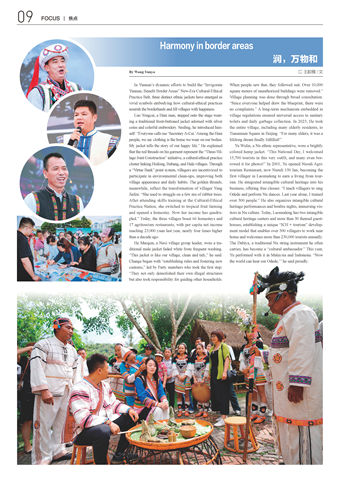
                                                             In Yunnan’s dynamic efforts to build the “Invigorate   When people saw that, they followed suit. Over 10,000
                                                          Yunnan, Benefit Border Areas” New-Era Cultural-Ethical   square meters of unauthorized buildings were removed.”
                                                          Practice Belt, three distinct ethnic jackets have emerged as   Village planning was done through broad consultation:
                                                          vivid symbols embodying how cultural-ethical practices   “Since everyone helped draw the blueprint, there were
                                                          nourish the borderlands and fill villages with happiness.  no complaints.” A long-term mechanism embedded in
                                                             Luo Yongcai, a Hani man, stepped onto the stage wear-  village regulations ensured universal access to sanitary
                                                          ing a traditional front-buttoned jacket adorned with silver   toilets and daily garbage collection. In 2023, He took
                                                          coins and colorful embroidery. Smiling, he introduced him-  the entire village, including many elderly residents, to
                                                          self: “Everyone calls me ‘Secretary A-Cai.’ Among the Hani   Tiananmen Square in Beijing. “For many elders, it was a
                                                          people, we say clothing is the home we wear on our bodies.   lifelong dream finally fulfilled!”
                                                          My jacket tells the story of our happy life.” He explained   Yu Wulin, a Nu ethnic representative, wore a brightly
                                                          that the red threads on his garment represent the “Three-Vil-  colored hemp jacket. “This National Day, I welcomed
                                                          lage Joint Construction” initiative, a cultural-ethical practice   15,700 tourists in this very outfit, and many even bor-
                                                          cluster linking Huilong, Bubang, and Hala villages. Through   rowed it for photos!” In 2001, Yu opened Nusuli Agri-
                                                          a “Virtue Bank” point system, villagers are incentivized to   tourism Restaurant, now Nusuli 150 Inn, becoming the
                                                          participate in environmental clean-ups, improving both   first villager in Laomudeng to earn a living from tour-
                                                          village appearance and daily habits. The golden threads,   ism. He integrated intangible cultural heritage into his
                                                          meanwhile, reflect the transformation of villager Yang   business, offering free classes: “I teach villagers to sing
                                                          Jiefen: “She used to struggle on a few mu of rubber trees.   Odede and perform Nu dances. Last year alone, I trained
                                                          After attending skills training at the Cultural-Ethical   over 300 people.” He also organizes intangible cultural
                                                          Practice Station, she switched to tropical fruit farming   heritage performances and bonfire nights, immersing vis-
                                                          and opened a homestay. Now her income has quadru-  itors in Nu culture. Today, Laomudeng has two intangible
                                                          pled.” Today, the three villages boast 66 homestays and   cultural heritage centers and more than 30 themed guest-
                                                          17 agritourism restaurants, with per capita net income   houses, establishing a unique “ICH + tourism” develop-
                                                          reaching 23,000 yuan last year, nearly four times higher   ment model that enables over 500 villagers to work near
                                                          than a decade ago.                           home and welcomes more than 230,000 tourists annually.
                                                             He Maogen, a Naxi village group leader, wore a tra-  The Dabiya, a traditional Nu string instrument he often
                                                          ditional male jacket faded white from frequent washing.   carries, has become a “cultural ambassador.” This year,
                                                          “This jacket is like our village, clean and tidy,” he said.   Yu performed with it in Malaysia and Indonesia. “Now
                                                          Change began with “establishing rules and fostering new   the world can hear our Odede,’” he said proudly.
                                                          customs,” led by Party members who took the first step:
                                                          “They not only demolished their own illegal structures
                                                          but also took responsibility for guiding other households.

