


Page 13 - YunnanTourismCultureTimes (117)
P. 13
12
                                                                                                                     FOCUS       |   焦点


                                                                                      Read More                                      阅读多一点
           One railway, one heart

           路,一条心                                                                         What is the “Invigorate Yunnan, Benefit
                                                                                                   Border Areas” initiative?

                                                                                                    “兴滇润边”是什么?


                                                                                       By Chen Chen, Shu Wen, and Luan Wenhua  □ 陈晨 舒文 栾文华 / 文
                                                                                         On November 4, our journalists joined the first group of thinktank ex-
                                                                                       perts and representatives from leading Marxist schools in Yunnan to launch
                                                                                       the province’s “Invigorate Yunnan, Benefit Border Areas” New-Era Cul-
                                                                                       tural-Ethical Practice Belt initiative. In Jinghong City, they took part in a
                                                                                       distinctive and grassrootsoriented “Neighborhood Story Session,” centered
                                                                                       on the theme “Invigorate Yunnan, Benefit Border Areas.” Experts offered
                                                                                       downtoearth statements such as “making border residents’ wallets fuller,”
                                                                                       “making villages more beautiful,” and “bringing neighbors closer together.”
                                                                                         What is the “Invigorate Yunnan, Benefit Border Areas” initiative?
                                                                                         Experts agreed that “Invigorate Yunnan, Benefit Border Areas” is
                                                                                       about bringing policies to the fireside and weaving development into
                                                                                       village life, creating a happiness that is tangible and real. In Laomanpo
                                                                                       Village, Mucheng Township, Longling County, improved infrastructure
                                                                                       has made daily life more convenient for border residents. Luojiaping
                                                                                       Village in Maguan County has woven civilized habits into routines
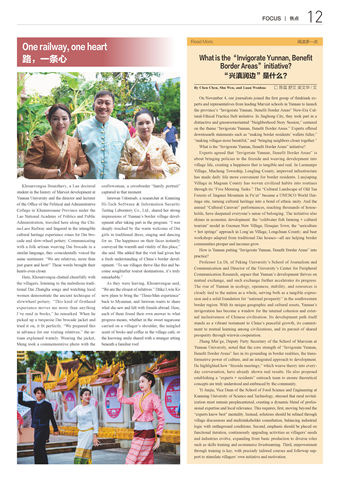
           Khounvongsa Bounthavy, a Lao doctoral   craftswoman, a crossborder “family portrait”
        student in the history of Marxist development at   captured in that moment.    through its “Five Morning Tasks.” The “Cultural Landscape of Old Tea
                                                                                       Forests of Jingmai Mountain in Pu’er” became a UNESCO World Her-
        Yunnan University and the director and lecturer   Jaruwan Udomsab, a researcher at Kunming
        of the Office of the Political and Administrative   Hi-Tech Software & Information Security   itage site, turning cultural heritage into a bond of ethnic unity. And the
                                                                                       annual “Cultural Caravan” performances, reaching thousands of house-
        College in Khammouane Province under the   Testing Laboratory Co., Ltd., shared her strong
        Lao National Academy of Politics and Public   impressions of Yunnan’s border village devel-  holds, have deepened everyone’s sense of belonging. The initiative also
                                                                                       shines in economic development: the “coldwater fish farming + cultural
        Administration, traveled here along the Chi-  opment after taking part in the program. “I was
        na-Laos Railway and lingered in the intangible   deeply touched by the warm welcome of Dai   tourism” model in Guomen New Village, Houqiao Town; the “sericulture
                                                                                       + hot springs” approach in Long’an Village, Longchuan County; and beer
        cultural heritage experience zones for Dai bro-  girls in traditional dress, singing and dancing
        cade and slow-wheel pottery. Communicating   for us. The happiness on their faces instantly   workshops adapted from traditional Dai houses—all are helping border
                                                                                       communities prosper and incomes grow.
        with a folk artisan weaving Dai brocade in a   conveyed the warmth and vitality of this place,”
                                                                                         How is Yunnan putting “Invigorate Yunnan, Benefit Border Areas” into
        similar language, they coincidentally voiced the   she said. She added that the visit had given her   practice?
        same sentiment: “We are relatives, more than   a fresh understanding of China’s border devel-
                                                                                         Professor Lu Di, of Peking University’s School of Journalism and
        just guest and host!” These words brought their   opment. “To see villages thrive like this and be-  Communication and Director of the University’s Center for Peripheral
        hearts even closer.                   come soughtafter tourist destinations, it’s truly
           Here, Khounvongsa chatted cheerfully with   remarkable.”                    Communication Research, argues that Yunnan’s development thrives on
        the villagers, listening to the melodious tradi-  As they were leaving, Khounvongsa said,   mutual exchange, and such exchange further accelerates its progress.
        tional Dai Zhangha songs and watching local   “We are the closest of relatives.” Htike Lwin Ko   The rise of Yunnan in ecology, openness, stability, and resources is
                                                                                       closely tied to the nation as a whole, serving both as a tangible expres-
        women demonstrate the ancient technique of   now plans to bring the “Three-Man experience”
        slowwheel pottery. “This kind of firsthand   back to Myanmar, and Jaruwan wants to share   sion and a solid foundation for “national prosperity” in the southwestern
                                                                                       border region. With its unique geographic and cultural assets, Yunnan’s
        experience moves me more than anything   what she saw and felt with friends abroad. Here,
        I’ve read in books,” he remarked. When he   each of them found their own answer to what   invigoration has become a window for the internal cohesion and exter-
                                                                                       nal inclusiveness of Chinese civilization. Its development path itself
        picked up a turquoise Dai brocade jacket and   progress means, whether in the sweet sugarcane
        tried it on, it fit perfectly. “We prepared this   carried on a villager’s shoulder, the mingled   stands as a vibrant testament to China’s peaceful growth, its commit-
                                                                                       ment to mutual learning among civilizations, and its pursuit of shared
        in advance for our visiting relatives,” the ar-  scent of books and coffee in the village café, or
        tisan explained warmly. Wearing the jacket,   the knowing smile shared with a stranger sitting   prosperity through winwin cooperation.
                                                                                         Zheng Min’ge, Deputy Party Secretary of the School of Marxism at
        Meng took a commemorative photo with the   beneath a familiar roof.
                                                                                       Yunnan University, noted that the core strength of “Invigorate Yunnan,
                                                                                       Benefit Border Areas” lies in its grounding in border realities, the trans-
                                                                                       formative power of culture, and an integrated approach to development.
                                                                                       He highlighted how “fireside meetings,” which weave theory into every-
                                                                                       day conversation, have already shown real results. He also proposed
                                                                                       establishing a “experts + residents” outreach team to ensure theoretical
                                                                                       concepts are truly understood and embraced by the community.
                                                                                         Yi Junjie, Vice Dean of the School of Food Science and Engineering at
                                                                                       Kunming University of Science and Technology, stressed that rural revital-
                                                                                       ization must remain peoplecentered, creating a dynamic blend of profes-
                                                                                       sional expertise and local relevance. This requires, first, moving beyond the
                                                                                       “experts know best” mentality. Instead, solutions should be refined through
                                                                                       village discussions and multistakeholder consultation, balancing industrial
                                                                                       logic with ontheground conditions. Second, emphasis should be placed on
                                                                                       functional iteration, continuously upgrading activities as villagers’ needs
                                                                                       and industries evolve, expanding from basic production to diverse roles
                                                                                       such as skills training and ecommerce livestreaming. Third, empowerment
                                                                                       through training is key, with precisely tailored courses and followup sup-
                                                                                       port to stimulate villagers’ own initiative and motivation.

